
From Cornfields to Field Margins:

How Harvest Mice Have Adapted to a Changing Countryside
Discover the secret life of one of Britain's smallest mammals
A harvest mouse weighs little more than a 2p coin, yet it is one of the most remarkable mammals found in the British countryside.
Tiny, agile and rarely seen, harvest mice spend much of their lives hidden among tall grasses, hedgerows and field margins. Their ability to climb slender stems, using their partially prehensile tails for support, allows them to inhabit a world that larger mammals can barely access.
Perhaps most famously, harvest mice build intricate spherical nests woven from living grass. These remarkable structures are among the most distinctive signs of their presence in the countryside.
But harvest mice are more than simply charming and unusual. They are closely associated with healthy, structurally diverse habitats, making them an important reminder of why hedgerows, rough grassland and uncut field margins matter for wildlife.
What is a harvest mouse?
The harvest mouse (Micromys minutus) is one of the smallest rodents in Europe and Britain's smallest rodent species.
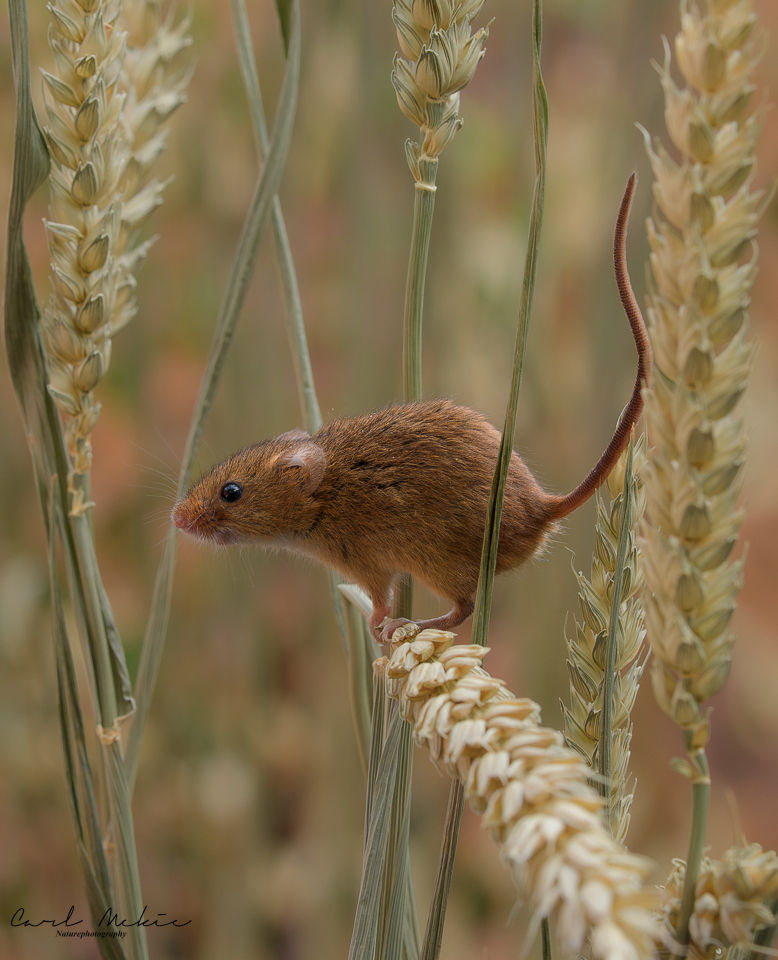
Adults typically measure around 5–8 centimetres in body length and weigh just a few grams. They have golden-brown or reddish-brown fur, a pale underside and a long tail that is almost as long as their body.
Unlike most other British mice, the harvest mouse has a partially prehensile tail. This means it can curl its tail around grass stems and use it for additional support while climbing.
This adaptation makes harvest mice exceptionally agile. Their lightweight bodies allow them to move through tall grasses and cereal crops, climbing stems that would be unable to support larger rodents.
In many ways, a meadow is an entire forest to a harvest mouse.
Harvest mouse habitat: where do harvest mice live?
Harvest mice depend on dense vegetation that provides food, shelter and places to nest.
Their preferred habitats include:

Tall grassland
Hedgerow bottoms and field edges
Cereal fields, particularly wheat and oats
Reed beds
Wetland margins
Ditches surrounded by long vegetation
Rough, unmanaged grassland
Bramble patches and scrubby corners of farmland
The most important feature of harvest mouse habitat is structure.
Short, closely managed grassland provides relatively little cover. By contrast, tall grasses and mixed vegetation create a complex environment with stems to climb, seeds to eat and sheltered areas for nesting.
This is why seemingly unimportant parts of the countryside can be vital for wildlife. A strip of rough grass beside a hedge may provide everything a harvest mouse needs to survive.
Where are harvest mice found in the UK?
Harvest mice are found across much of Europe and parts of temperate Asia.
In Britain, they are widespread but patchily distributed. They are most commonly associated with England and Wales, while records are less frequent in Scotland.
Their distribution is closely linked to the availability of suitable habitat. In areas where hedgerows, field margins and rough grassland have been removed or heavily managed, harvest mouse populations can become isolated.
Connected habitats are particularly important. Hedgerows, grassy margins, ditches and wetland edges can act as wildlife corridors, allowing small mammals to move safely through the landscape.

The famous harvest mouse nest
One of the most fascinating things about harvest mice is the nest they build.
A harvest mouse nest is usually spherical and woven from grass blades. Often around the size of a tennis ball, it can be suspended among standing vegetation above the ground.
Unlike a simple bundle of grass, the nest is carefully constructed. The mouse splits, bends and weaves grass blades together, often using living stems that remain rooted in the ground.
The result is a surprisingly strong and well-hidden structure.
Breeding nests and winter nests
Female harvest mice build carefully woven nests during the breeding season to raise their young.
Winter shelters may be less elaborate and are often found closer to the ground, where dense vegetation provides protection from cold weather.
Because harvest mice themselves are difficult to see, finding one of their nests is often the easiest way to discover that they are present in an area.
For many wildlife enthusiasts, the first evidence of a harvest mouse is not the animal itself, but the tiny woven home it has left behind.
What do harvest mice eat?
Harvest mice have a varied diet that changes throughout the year.
They eat:
Seeds and grass seeds
Cereal grains
Berries and other plant material
Insects
Small invertebrates
During warmer months, insects can provide an important source of protein. Seeds and grains become particularly valuable later in the year.
Their climbing ability gives them access to food high above the ground. Rather than searching only among leaf litter and vegetation at ground level, harvest mice can move directly through grass stems and seed heads.
This ability allows them to take advantage of food resources that may be inaccessible to larger or less agile rodents.

Are harvest mice nocturnal?
Harvest mice are generally most active around dusk, dawn and during the night, although they may also be active during daylight hours.
Their secretive behaviour and preference for dense vegetation mean they are rarely seen by people.
Even in places where harvest mice are present, they can remain almost completely hidden.
Their small size is one advantage. A harvest mouse can move quietly through tangled vegetation, disappearing among grass stems and leaves within seconds.
Harvest mouse life cycle and reproduction
Harvest mice have relatively short lives and face numerous dangers in the wild.
To compensate, they reproduce quickly during favourable conditions.
The breeding season generally takes place during the warmer months, when food and nesting materials are more readily available. Females can produce several litters in a year, with each litter containing multiple young.
The young grow rapidly and become independent within a relatively short period.
This fast reproductive cycle is an important survival strategy for a small mammal with many natural predators.
However, reproduction alone cannot protect a population if suitable habitat disappears.
Without tall grasses, hedgerows and sheltered field margins, harvest mice have fewer places to feed, nest and avoid predators.
What eats harvest mice?
Because of their small size, harvest mice are prey for a wide range of animals.
Natural predators include:

Owls
Kestrels and other birds of prey
Weasels
Foxes
Domestic and feral cats
Their main defence is often concealment.
Dense vegetation provides protection from predators, while their climbing ability allows them to move through a three-dimensional environment that can be difficult for larger animals to navigate.
But habitat loss can make this strategy much less effective.
When grassland is cut, hedgerows are removed or field margins disappear, harvest mice lose the cover they depend upon.
Threats to harvest mice in Britain
The greatest challenges facing harvest mice are often linked to changes in the countryside.
Habitat loss
Modern agricultural practices have led to the loss of many hedgerows, rough grassland areas and field margins.
While productive farmland remains essential, wildlife can struggle when every part of the landscape is intensively managed.
Harvest mice depend heavily on the transitional spaces between fields and habitats.
Mechanical mowing and harvesting
Cutting large areas of vegetation can remove food, shelter and nesting sites.
Mowing or harvesting at sensitive times can also disturb wildlife living within long grass and field margins.
Wildlife-friendly management often involves leaving some areas uncut or managing vegetation in stages rather than removing all cover at once.
Habitat fragmentation
Even when suitable habitat survives, isolated patches may not be enough.
A network of connected hedgerows, grass margins and wetland vegetation gives harvest mice and other small animals opportunities to move through the landscape.
How can we help harvest mice?
Protecting harvest mice does not necessarily require creating large new nature reserves.
Small changes to habitat management can make a significant difference.
Ways to create harvest mouse-friendly habitat include:
Leaving areas of grass uncut
Maintaining wide field margins
Protecting established hedgerows
Restoring native hedgerows and scrub
Retaining rough vegetation around ditches and ponds
Avoiding cutting all vegetation at the same time
Creating connected wildlife corridors across farmland
The principle is simple: wildlife needs variety.
A landscape containing short grass, tall grass, hedgerows, scrub and wetland edges will usually support far more species than one that is uniformly managed.
How to spot harvest mice and their nests
Seeing a harvest mouse in the wild can be difficult, but evidence of their presence may be easier to find.
The best places to look include areas with:
Tall, dense grasses
Hedgerow margins
Reed beds
Wetland vegetation
Rough field edges
A harvest mouse nest is one of the most distinctive signs. These woven, spherical structures are carefully hidden among vegetation and may be discovered when grass dies back later in the year.
However, care should always be taken when searching for wildlife.
Nests can be fragile, and harvest mice or other animals may still be using nearby vegetation. It is important not to disturb habitat unnecessarily.
Anyone interested in surveying harvest mice should follow guidance provided by wildlife organisations or local recording groups.
Why harvest mice matter
Harvest mice are easy to overlook.
They are tiny, quiet and rarely seen. They don't dominate the landscape or attract the attention given to larger mammals.
Yet their presence tells us something important about the health of the countryside.
Harvest mice depend on the complex, untidy spaces that are often removed from modern landscapes: long grass, hedgerow bottoms, field margins and wetland edges.
Protecting these habitats benefits far more than one small rodent. The same vegetation can support insects, birds, amphibians and countless other mammals.
Final thoughts: protecting the small spaces
The harvest mouse may be one of Britain's smallest mammals, but it carries a big conservation message.
Healthy landscapes are not made up of individual habitats existing in isolation. They depend on connections — the hedgerows between fields, the grass beside a ditch and the rough corners that are sometimes considered untidy or unproductive.
For a harvest mouse, a patch of long grass can provide food, shelter, a nesting site and protection from predators.
It is a reminder that conservation does not always mean doing more.
Sometimes, it means knowing what to leave alone.
By protecting hedgerows, allowing field margins to grow and supporting wildlife-friendly land management, we can help ensure that Britain's smallest rodent continues to weave its remarkable nests into the countryside for generations to come.


cute